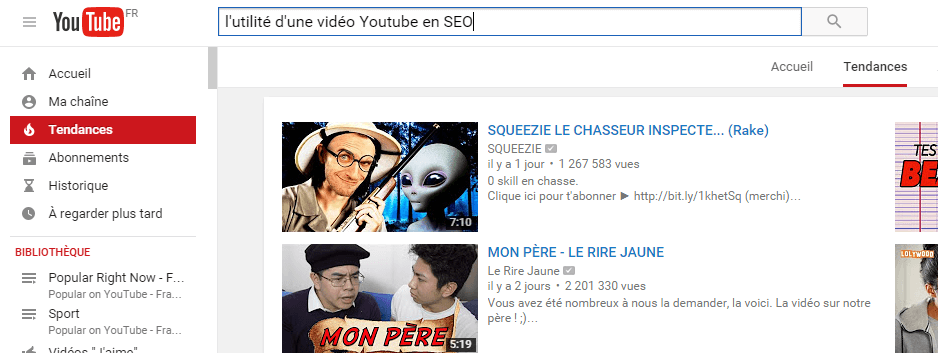
Reading the title, many will wonder what a YouTube video could possibly bring to a page's SEO strategy. And yet embedding a video makes sense: it keeps the visitor engaged, complements a short text and, well described by its metadata, it can even get the page into Google's video results.
You can't always write 1,000 words
With Google, we know it, content has clearly become one of the main criteria of its algorithm for ranking pages in the SERPs. A few years ago you could still rank a site and its pages without much content, but that has become very difficult. You can try piling on a bunch of quality links, but it is no longer enough, or only rarely.
Yet it is still possible to rank sites that offer little or no content. Take an example: how many SEOs would answer yes to the question "Can you rank a page with only 40 words?" It is understandable, today we live in the cult of endless pages where people write for the sake of writing, filling the text as much as possible to satisfy Googlebot. Yet there are other tricks worth testing instead of struggling with words.
Images and video, safe bets
Indeed, I have noticed that you don't need pages with thousands of words to rank and generate traffic. It was while talking with an SEO many people know (Olivier, if you're reading this) that we came to this conclusion. On one of his sites, whose URL we will keep to ourselves, there is almost no text. Instead, each page, besides about thirty words, has an image and a video.
This is where you can see the full power of a video. Google ranks the pages very well, even though there is nothing in them and the linking is really nothing special. How can this be explained, if not by the fact that the video's content brings real added value to an almost nonexistent content strategy? Just test it, I think it can clearly be a solution if the video's title is relevant to the queries you target on your page.
How Google detects a YouTube video embedded in a page
An embedded YouTube video is not read as a mere player dropped in the middle of the page: Google recommends giving it metadata, through VideoObject structured data, a video sitemap or the Open Graph protocol. In its Search Central documentation, it asks for a name, a description and a thumbnail specific to each video, as well as the address of the embedded player.
Google also distinguishes the watch page, whose purpose is to show a single video, from the article that embeds a video to complement its text. A short page built around a video is closer to the first case; a long post that inserts a video among other content falls under the second. This difference matters for display in video results, and it ties in with the experience described above: little text, one central, well-titled video.
Making the most of a YouTube video on a short page
The video doesn't do the work on its own. A few simple settings increase its chances of carrying the page:
- choose a video whose title matches the query targeted by the page;
- place the player at the top of the page, where it is visible without scrolling;
- write a few lines summarizing the video with the words of the topic;
- take care of the title tag and the description, which users read before clicking: knowing how to write a useful meta description helps as much here as on a long page;
- describe the video with VideoObject structured data.
A video published on your own channel brings one more advantage: its title and description on YouTube are written with the same keywords as the page, and the video's description can link back to the site.
The limits of video for SEO
Video doesn't replace everything. A YouTube player loaded as soon as the page opens makes it heavier, especially on mobile; a deferred load of the player, which first shows only the thumbnail, limits this drawback. On a query where the visitor expects a detailed written answer, an almost empty page will make them leave: there, the video complements a text, it doesn't replace it.
My advice remains the same: test. On a low-competition query, a short page carried by a well-titled video can rank; on a competitive query, the video mainly serves to keep the reader longer and to enrich content that is already solid.